

Is the Right Entity Insured?
Named Insured and LLC Title Mismatches in Real Estate Deals
What attorneys should confirm when the entity on the deed and the entity on the policy don't match
Short answer: the named insured on a property or liability policy should be the entity that holds title. When an investor deeds a property into an LLC but leaves the policy in their own name, the carrier can dispute a property claim, and the LLC formed to limit the investor's liability may have no liability coverage at all. The attorney who forms the entity and records the transfer is usually the only advisor positioned to catch the mismatch before it matters.
Why the Mismatch Happens
Real estate investors restructure ownership often: for liability protection, for financing, for estate planning, or to complete a 1031 exchange. Each change moves title. Insurance does not follow on its own. A policy stays with whoever was named when it was bound until someone asks the carrier to endorse it.
The attorney records the deed, the client assumes the paperwork is finished, and nobody calls the insurance advisor. Months later the declarations page and the deed name different owners, and the gap surfaces only when there is a loss or a lawsuit.
Five Common Mismatches
1. Property Deeded into an LLC After Closing
An investor buys in their own name, often to simplify financing, then deeds the property into a single-member LLC. The policy still names the individual.
On the property side, the carrier may question whether the individual still has an insurable interest in a building they no longer own. Courts have split on whether an LLC member has an insurable interest in the LLC's property, so the outcome depends on the state and the facts. Even a claim that is eventually paid can be delayed while that is argued.
On the liability side the problem is sharper. The standard commercial general liability form (ISO CG 00 01) does not cover the conduct of a limited liability company unless it is shown as a named insured on the declarations. If the named insured is an individual, coverage generally applies only to a business the individual owns as a sole proprietor, which an LLC is not. The entity created to shield the investor can be sued with no defense from the policy.
Attorney takeaway: when you prepare a deed into an entity, advise the client in writing to have the policy endorsed to name the LLC, effective on the date of transfer.
2. A Fix-and-Flip Property Insured on the Wrong Form
An LLC buys a property to renovate and sell. The investor buys a homeowners or dwelling policy because it is fast and inexpensive. That policy can fail twice.
First, the form. Homeowners policies are built for a residence the insured lives in, and a flip is neither occupied nor a residence of the owner. Some dwelling programs will not write an entity as the insured at all.
Second, vacancy. Dwelling forms commonly restrict coverage once a property has been vacant for 60 consecutive days, and vandalism is typically among the losses excluded. The commercial property form (ISO CP 00 10) applies a similar 60-day rule that removes coverage for vandalism, theft, water damage, and several other causes, and reduces payment on the rest by 15%. That form does treat a building under construction or renovation as not vacant, but a stalled project invites the argument.
The right answer is usually a vacant-property, renovation, or builder's risk form written in the LLC's name, with the lender shown as mortgagee. Many of these risks place in the surplus lines market.
Attorney takeaway: in a flip, ask which form the coverage is written on and whom it names, not just whether the property is insured.
3. 1031 Replacement Property Held Through a TIC, DST, or Accommodation Titleholder
Exchange structures add owners the insurance often misses.
Tenancy in common. Each co-owner holds an undivided interest. A policy written in one co-owner's name can leave the others without coverage for their share. All co-owners, or their entities, should be named.
Delaware statutory trust. The trust holds title and the sponsor arranges coverage. Investors are generally not insureds, so confirm the sponsor's program and limits during diligence.
Reverse and improvement exchanges. Under the safe harbor in Revenue Procedure 2000-37, an exchange accommodation titleholder (EAT) holds title during the parking period, usually through a single-purpose LLC. The policy should name that entity. If construction happens during an improvement exchange, builder's risk may be needed in the EAT's name. The accommodation agreement usually spells out the insurance requirements, including how the taxpayer appears on the policy.
Attorney takeaway: whoever holds title on the transfer date is the entity the insurance must name, even if that entity holds title for only a few months.
4. Lender, Borrower, and Policy That Don't Line Up
Private and bridge lenders typically require the borrowing entity as named insured, the lender as mortgagee on the property policy, and the lender as additional insured on the liability policy. If the borrower is the LLC but the policy names its member, the closing condition is not actually met.
Some lenders catch it at funding and delay the closing. Others catch it later and force-place coverage at the borrower's expense. The mortgagee clause protects the lender in many situations where the borrower's own coverage fails, but it does nothing for the borrower's equity or liability exposure.
Attorney takeaway: match three names before funding: the vesting on the deed, the borrower on the note, and the named insured on every declarations page.
5. Anonymity Structures Disclosed Late
Investors who value privacy often hold property in an LLC owned by a trust or another entity, so their own name appears nowhere in the public record. That structure is legitimate, and it can be insured. What causes trouble is when the insurance advisor learns about it late.
From our files: an investor called for coverage on rental properties he said were owned by an LLC, and asked us to move quickly. We quoted on that basis, and the pricing came in well. Only then did he explain that the LLC was owned by a trust and that he wanted his name kept off everything. Premium was never the issue. The carrier had to underwrite the ownership structure itself before it could bind, and no broker can make an underwriter skip that review. The carrier ultimately approved the structure, but the added time ran past the date he had in mind.
The structure was not the problem; the timing of its disclosure was. Had the full ownership chain been on the table at the first call, the underwriting review would have run alongside the quote rather than after it.
Land trusts raise the same issue in a sharper form. A land trust is not an entity. The trustee holds legal title and is the name in the public record, while the beneficiary, often the investor's LLC, keeps possession, management, and the economic interest. Florida and Illinois recognize land trusts by statute; many states, including California, do not, and carriers handle them inconsistently. The structure that works is to name the trustee, as trustee of the specific trust, together with the beneficiary as named insureds. Carriers can accept that arrangement, and in our experience they do, but usually only after an underwriting review, so build the time into the schedule.
Every one of these structures can keep an investor's name out of the public record. None of them keeps it from the insurer. The carrier needs an identifiable person behind the structure who signs the application, makes decisions on the policy, receives claim payments, and can be verified. Privacy is from the public, not from the carrier.
Attorney takeaway: if you set up a privacy structure, tell the client to disclose the complete ownership chain, every entity and trust between the property and the people behind it, the first time they request insurance. The declarations page can usually still show the entities rather than the individuals behind them.
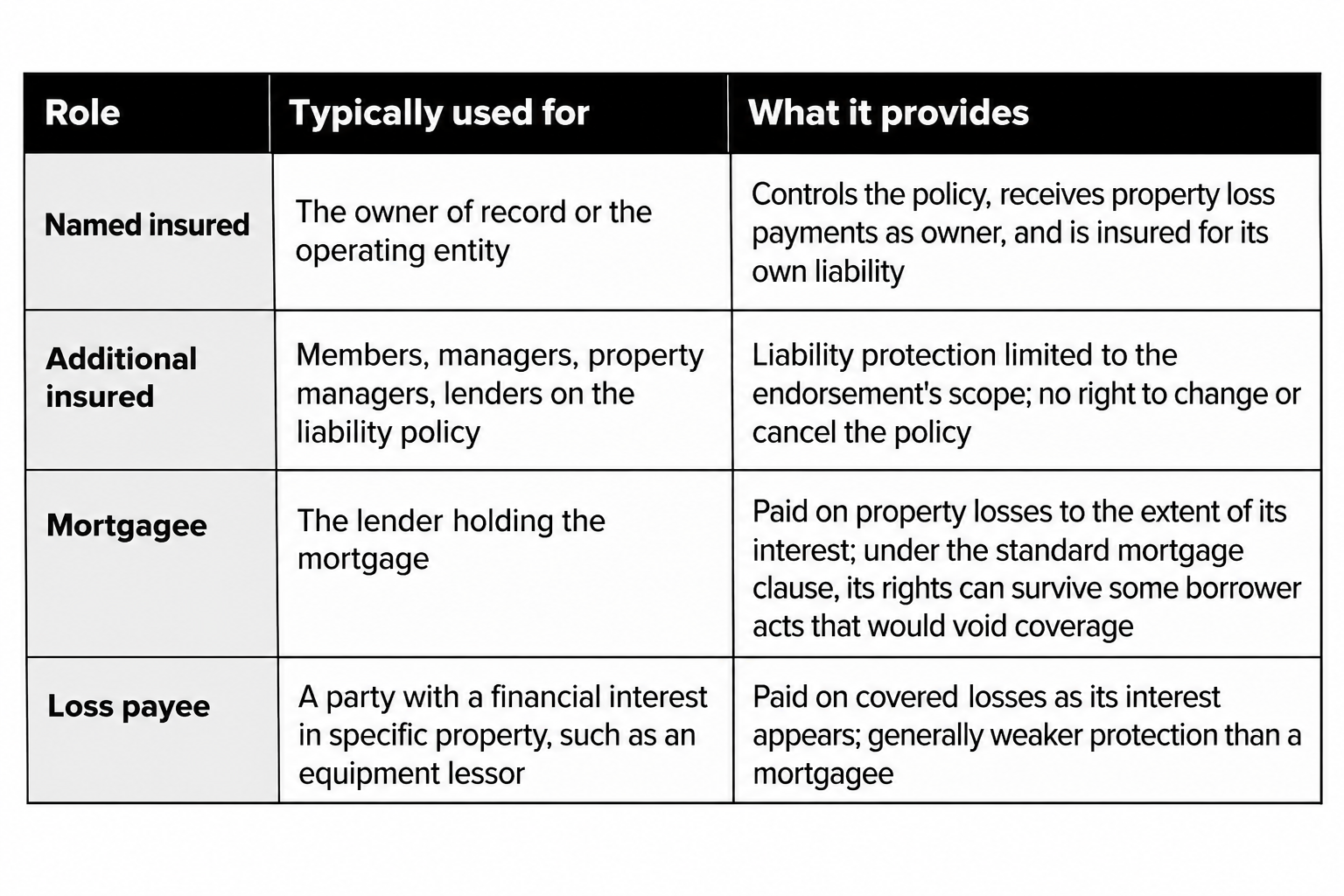
Named Insured, Additional Insured, Mortgagee, Loss Payee: What Each Gets
These roles are often treated as interchangeable. They are not, and the difference decides who controls the policy and who gets paid.
Checklist for Attorneys

1. Does the named insured match the vesting on the deed exactly, including the full entity name?
2. If title will move after closing, who is responsible for endorsing the policy, and by what date?
3. Is the LLC a named insured on the liability policy, not just the property policy?
4. Is the form right for the use: vacant, under renovation, rented, or owner-occupied?
5. For a TIC, is every co-owner insured? For a reverse or improvement exchange, does the policy meet the accommodation agreement?
6. If the owning entity is held by a trust or another entity, has the full ownership chain been disclosed to the insurance advisor?
7. Do the mortgagee and additional insured wording match the loan documents?
Language Attorneys Can Use
A short advisory in the closing letter or post-transfer email puts the responsibility where it belongs. Adapt as needed:
Title to [property address] is now held by [Entity Name], effective [date]. Insurance does not transfer with the deed. Before [date], please contact your insurance advisor to have each property and liability policy endorsed to name [Entity Name] as the named insured, effective on the transfer date, and to update your lender's mortgagee clause. If the property is vacant or under renovation, ask whether your current policy form still applies.
Frequently Asked Questions
Should a rental property owned by an LLC be insured in the LLC's name?
Yes. The entity that holds title should be the named insured on both the property and liability policies. Members or managers can be added as additional insureds where appropriate, but the owner of record belongs on the declarations page.
Is my insurance still valid after I transfer my property to an LLC?
No. The policy stays with whoever was named when it was bound. The carrier has to endorse the change, ideally effective the same day as the transfer. Until then, the deed and the policy name different owners.
Does an LLC member have an insurable interest in property the LLC owns?
It depends on the state and the facts. Courts have reached different results, and a carrier can dispute or delay a claim while the question is argued. Naming the LLC as the insured avoids the issue entirely.
Is adding the LLC as an additional insured enough?
Usually not. An additional insured has narrower rights than a named insured and typically cannot control the policy or receive property loss payments as the owner. The title-holding entity should be a named insured.
Can a homeowners policy cover a fix-and-flip property?
Generally no. Homeowners forms are built for a residence the insured lives in, and a flip is vacant or under renovation. Flips need a vacant-property, renovation, or builder's risk form written in the owning entity's name.
Who should be insured during a reverse or improvement 1031 exchange?
The exchange accommodation titleholder, or its single-purpose LLC, holds title during the parking period, so the policy should name that entity. The accommodation agreement usually sets the insurance requirements, including the taxpayer's status on the policy.
Can property owned by an LLC that is held in a trust be insured without naming the individual owner?
Usually the declarations page can show only the LLC. The carrier will still need to know the full ownership chain, including the trust and the people behind it, to complete underwriting and its own compliance review. Disclosing the structure in the first conversation keeps that review from delaying a closing.
How do you insure property held in a land trust?
Name the trustee, as trustee of the specific land trust, and the beneficiary as named insureds. The trustee holds legal title, while the beneficiary controls and benefits from the property. Many carriers accept this structure but refer it to an underwriter first, so disclose the trust and the beneficiary when coverage is first requested.
How can an attorney confirm the insurance matches the deal structure?
Compare the named insured on each declarations page with the vesting on the deed and the borrower on the loan documents. BFIS reviews declarations against vesting for attorneys and their clients and can endorse or re-place coverage before closing or after a transfer.
Work with an Insurance Advisor Who Reads the Deed
Brighton Financial & Insurance Services (BFIS) places commercial real estate insurance, builder's risk, and vacant and renovation property coverage for investors, developers, and lenders, including surplus lines placements for risks admitted carriers decline. With offices in San Ramon, California and Fort Lauderdale, Florida, and a principal licensed in 30 states, BFIS works with the attorneys and CPAs who structure these deals.
For attorneys: send us the vesting deed and the current declarations pages, and we will confirm whether they match, before closing or after a transfer.
Talk to a commercial insurance specialist: call (888) 412-7630, email vernon@thebfis.com, or contact us online.
About the Author
Vernon Williams is the principal of Brighton Financial & Insurance Services. He is a licensed insurance broker in 30 states, holds a California surplus lines license, and places commercial real estate, builder's risk, and hard-to-place property risks for investors, developers, and lenders.
Last reviewed: October 2026.
This article is general information for legal and real estate professionals. It is not legal advice. Coverage depends on the actual policy forms and endorsements, and insurable-interest questions depend on state law.
Insurance and Commercial Real Estate Closings: A Pre-Closing Checklist for Attorneys

How CPAs Can Help Clients Avoid Commercial Property Insurance Gaps

What Happens When Builder's Risk Insurance Ends?